From Words to Weapons: Sam Altman Addresses Molotov Attack and AI Anxiety
OpenAI CEO Sam Altman has issued a vulnerable response following a terrifying incident where a Molotov cocktail was thrown at his San Francisco home in the early hours of Friday morning. While no one was injured, the attacker was later apprehended after threatening to burn down OpenAI’s headquarters. Altman linked the escalation of violence to the “power of words,” specifically pointing to a recent, highly critical New Yorker profile titled “Sam Altman May Control Our Future—Can He Be Trusted?” which he initially labeled as “incendiary” before walking back the term.

In a personal blog post, Altman admitted he had underestimated how media narratives can fuel real-world danger during a time of peak societal anxiety over AI. Sharing a rare photo of his husband and son to humanize the stakes, he acknowledged past mistakes—including his “conflict-averse” nature and the messy 2023 board coup—while calling for a de-escalation of industry rhetoric. He emphasized that while the fear surrounding AGI is justified, the debate should focus on policy and democratization rather than physical or figurative “explosions” at the homes of those building it.
The “Claw” Back: Anthropic Suspends OpenClaw Creator Amid Growing AI Platform Tensions
Anthropic briefly suspended the account of Peter Steinberger, the creator of the popular open-source AI agent framework OpenClaw, citing “suspicious activity.” The ban, which lasted only a few hours on Friday before being reversed, occurred just days after Anthropic announced a major policy shift: standard Claude subscriptions will no longer cover third-party “claws” or automation tools. Instead, developers must now pay for these high-compute reasoning loops via the Claude API. Steinberger, who recently joined OpenAI to lead their personal agent strategy, claimed he was already compliant with the new pricing when his access was revoked.

The incident has sparked a heated debate within the developer community regarding “platform risk” and anti-competitive behavior. Steinberger and other critics noted that the suspension and pricing changes coincided with Anthropic’s launch of its own proprietary agent features, suggesting the company may be squeezing out open-source alternatives to favor its native tools. While Anthropic engineers attributed the ban to automated “suspicious signals” rather than a deliberate move against OpenClaw, the event highlights the fragile power dynamics between model providers and the independent developers building on top of them.
The $100 Subscription: OpenAI Debuts “ChatGPT Pro” Powered by New Codex Model
OpenAI has officially launched its most expensive consumer tier to date, “ChatGPT Pro,” priced at $100 per month. The centerpiece of this plan is the exclusive debut of “Codex-2,” a next-generation reasoning model specifically optimized for deep-level software engineering and complex mathematical proofs. Unlike the standard Plus tier, Pro users receive unlimited “priority” access during peak hours and a massive 256k context window, allowing the model to ingest and analyze entire codebases or lengthy technical manuscripts in a single prompt.

Beyond raw power, the Pro plan introduces a suite of advanced productivity features, including “Live Canvas” for real-time collaborative coding and a dedicated sandbox for executing and testing Python scripts in a secure environment. Industry analysts suggest this move marks OpenAI’s transition from a general-purpose assistant to a specialized professional tool, targeting high-end developers and researchers who require more than what the standard model offers. While the price point has sparked debate, the company argues that the productivity gains from the new Codex architecture justify the “prosumer” investment.
Distribution Over Benchmarks: Meta AI Climbs to No. 5 Following “Muse Spark” Launch
Meta’s standalone AI app has skyrocketed from 57th to 5th place on the U.S. App Store just days after the release of its new “Muse Spark” reasoning model. The surge highlights a major victory for Meta’s “distribution-first” strategy, proving that deeply integrating AI into a massive social ecosystem can rival the hype of competitors like OpenAI and Google. While rivals focus on raw benchmark scores, Meta is betting on accessibility, positioning Muse Spark as a “personal superintelligence” that lives where users already spend their time—across Instagram, WhatsApp, and Facebook.

Muse Spark is a natively multimodal model designed for speed and real-world utility, featuring a unique “Contemplating” mode that uses parallel AI sub-agents to solve complex tasks. While it slightly trails leaders in coding and abstract logic, it has set new records in specialized fields, notably outperforming GPT-5.4 in health and medical reasoning. The launch also marks a historic strategic shift: Muse Spark is Meta’s first major proprietary, closed-source model, signaling that the company is moving away from its open-source “Llama” roots to better monetize its $100B+ investment in AI infrastructure.
Binge-Watching Meets AI: Tubi Debuts First-of-Its-Kind Native Streaming App in ChatGPT
Tubi has made history as the first streaming service to launch a native application directly within the ChatGPT interface. This integration goes far beyond a simple recommendation plugin; it allows users to search, discover, and play content from Tubi’s massive library of 250,000 movies and TV shows without ever leaving the chat window. Powered by a custom GPT, the app uses conversational intelligence to understand nuanced requests—like “find me a 90s thriller with a twist ending”—and provides a synchronized “Watch Party” feature for users to stream simultaneously with the AI or friends.
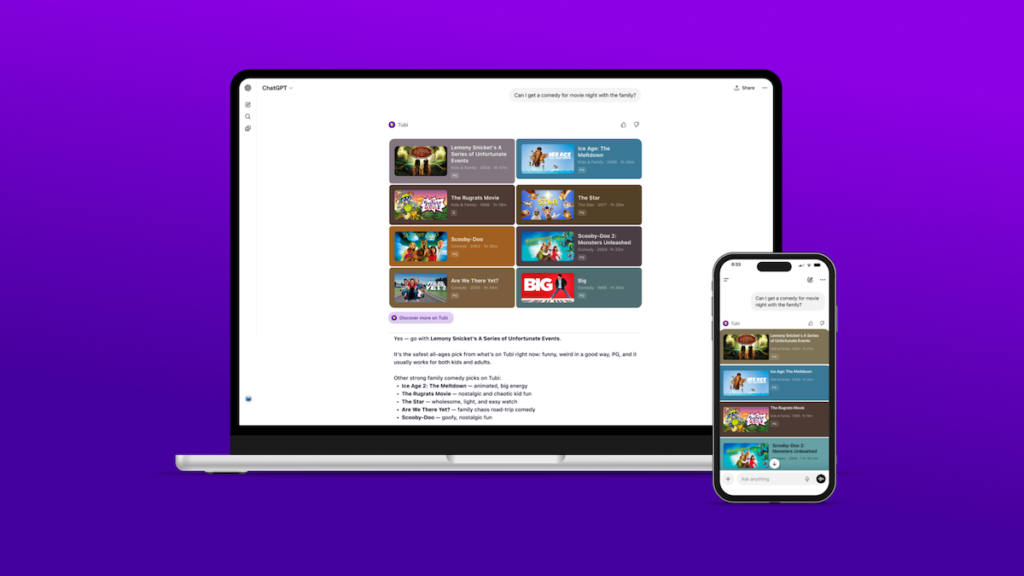
The move signals a major shift in how digital media is consumed, moving away from traditional grid-based interfaces toward “intent-based” browsing. While the video player is currently restricted to the ChatGPT desktop and mobile apps, it offers a seamless, ad-supported experience that leverages OpenAI’s reasoning capabilities to provide real-time trivia and context about the films being watched. For Tubi, this partnership offers a massive new distribution channel, while for OpenAI, it represents a significant step toward turning ChatGPT into an all-in-one operating system for both productivity and entertainment.
Private by Default: Google’s New Offline AI Dictation App Challenges the Cloud-First Norm
Google has quietly launched “Listen & Layer,” a new iOS application that provides high-speed, AI-powered transcription and dictation entirely on-device. Unlike previous iterations of Google’s voice tools that relied on server-side processing, this app uses a miniaturized version of the Gemini Nano model to convert speech to text without an internet connection. The app is designed for “extreme privacy,” ensuring that sensitive voice data never leaves the user’s phone, which positions it as a direct competitor to Apple’s native dictation and specialized apps like Otter.ai.
Beyond simple transcription, the app introduces a “Layering” feature that allows users to organize thoughts into structured formats—such as meeting minutes, to-do lists, or draft emails—using local processing power. By prioritizing an offline-first architecture, Google is addressing the growing demand for data sovereignty and reliability in areas with spotty connectivity. While the initial release lacks the cloud-synced features of the broader Google Workspace, its speed and commitment to privacy mark a significant strategic pivot toward edge-based AI for everyday productivity.