Sora’s Shutdown: A Wake-Up Call for the AI Video Boom?
OpenAI has announced it will shut down its Sora video‑generation app and associated video models just six months after launch, marking a surprising retreat from the consumer AI video space at a time when excitement around generative video technology was high. The decision reflects OpenAI’s shift in focus toward enterprise and productivity tools, especially as it prepares for a possible IPO, and suggests that flashy AI video tools may be less viable than once predicted.
Industry observers argue that Sora’s closure could serve as a wake‑up call for the broader AI video market, highlighting both technical and legal challenges — from high compute costs and ethical concerns around deepfakes to stalled user growth — while dampening overly optimistic claims that AI video will soon replace traditional Hollywood production. Instead, the shutdown could signal a move toward more pragmatic AI deployments and a reassessment of where generative video fits into the future of AI innovation.
Elon Musk’s Last Co-Founder Exits xAI, Marking a Leadership Shift
Elon Musk’s AI startup, xAI, has lost its last original co‑founder, Ross Nordeen, who has reportedly left the company. This marks the complete departure of the founding leadership team, following a series of exits over the past few months. Nordeen had been central to the operations of xAI, which was initially launched to rival industry giants like OpenAI.

The series of departures raises questions about xAI’s future as it undergoes restructuring under Musk’s leadership, especially after being acquired by SpaceX. Musk has admitted that the company’s initial structure was flawed and is now working to rebuild it from the ground up. This leadership shift could impact xAI’s ability to stay competitive in the rapidly evolving AI space.
Mistral Unveils Voxtral TTS: Open‑Source Speech AI for the Next Generation of Voice Assistants
French AI startup Mistral AI has launched a powerful new open‑source text‑to‑speech (TTS) model called Voxtral TTS, expanding its suite of generative AI tools into high‑quality speech generation. Designed to help enterprises and developers build natural‑sounding voice agents — from customer support bots to sales assistants — the model supports nine languages including English, French, Spanish and Hindi, and can even clone voices using just a few seconds of sample audio. Voxtral TTS is optimized for fast, low‑latency performance and can run efficiently on everything from cloud servers to edge devices like smartphones and smartwatches, giving users flexibility to deploy it on their own terms.

By making Voxtral TTS fully open‑weight and available under an open‑source license, Mistral aims to challenge proprietary players like ElevenLabs, Deepgram and OpenAI in the voice AI market — allowing companies to own and customize their voice AI stack without relying on external APIs. This move underscores a broader shift in the AI industry toward more accessible and developer‑friendly tools that bring advanced speech capabilities to a wider ecosystem of applications.
Melania Trump Envisions Robots as Future Homeschool Teachers
First Lady Melania Trump has thrown her weight behind a bold vision for the future of education, suggesting that humanoid robots could one day homeschool children and provide personalized learning experiences right in the home. At a White House event for her new initiative Fostering the Future Together, she appeared alongside a humanoid robot developed by robotics firm Figure AI, which spoke briefly and demonstrated how technology could be part of children’s learning environments. Trump asked educators and attendees to imagine a future where robots like the hypothetical “Plato” deliver adaptive instruction across subjects — from science to history — tailoring education to each student’s pace and needs.
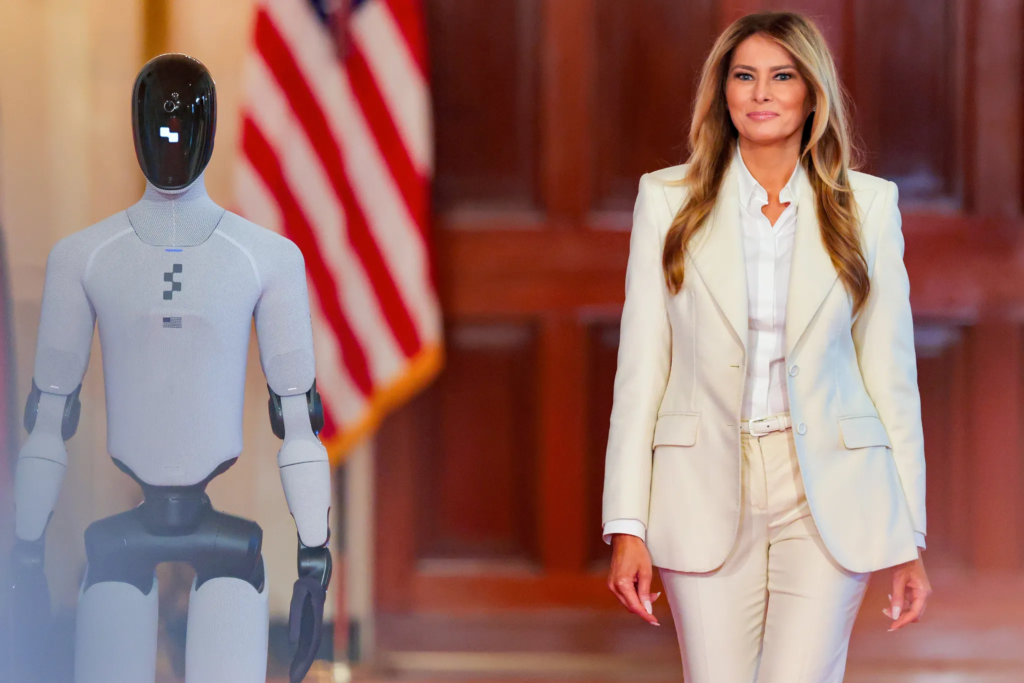
Her remarks underscored the administration’s belief in the growing role of AI and robotics in education, emphasizing that such tools might help foster critical thinking and independent reasoning while broadening access to knowledge. While this vision is far from current classroom realities, it reflects a broader push by tech advocates and policymakers to integrate advanced technologies into learning. The proposal has sparked debate about the role of robots versus human teachers in children’s academic and social development.
Google’s Lyria 3 Pro Brings Full‑Length AI‑Generated Music to the Mainstage
Google has unveiled Lyria 3 Pro, its latest and most advanced generative AI music model, designed to create longer, more structured songs than its predecessor. While the earlier Lyria 3 model was limited to roughly 30‑second clips, Lyria 3 Pro can now generate tracks up to three minutes long, complete with musical elements like intros, verses, choruses, and bridges — offering creators much greater creative control over composition.
The upgraded model is being rolled out across a range of Google products, including the Gemini app, Vertex AI, and tools like Google Vids and ProducerAI, making it accessible to both individual users and developers. Google emphasizes that Lyria‑generated music avoids copying specific artists and embeds SynthID watermarks to identify AI‑created tracks, as part of its efforts to balance innovation with ethical use and originality.